Grieving the End of a Journey

A Therapist Retires

Last October, our team gathered for our annual retreat. We were grieving some changes in our practice; we had some decisions to make regarding our direction and priorities. To help with this, we spent time revisiting our vision and values and seeking God. During that time of prayer and soul searching, I began to sense that perhaps it was time for me to consider retiring.

We all talked it through and invited Radu (Karis’s husband and our bookkeeper) and Don (my husband and our accountant – we like keeping it in the family!) to share their thoughts as well. I assured Kiki and Karis that I would remain connected to the practice. As such, I’ll continue to provide oversight and leadership as they grow until they are comfortable taking everything over in a few years.

As I look toward retirement, I have thought a lot about the work I’ve done. I’ve seen marriages strengthened and clients who have “graduated therapy” after growing and healing tremendously. Some clients weren’t ready to do the work and ended therapy prematurely. Many others have grown SO much, yet who will need therapeutic support beyond my time.

As I reflect, it brings to mind the thoughts I had when my oldest daughter, Hannah, entered high school. I remember thinking, “I have four short years to get her ready to live independently!” Somewhere between her sophomore and junior years, it began to occur to me that I would be sending her off not fully ready to “adult”. As I wrestled with that, I felt God tell me I had to let go and to trust she would find her way on her journey.

And now, as I prepare to retire in September, I have so much more confidence in letting go. I know that the work isn’t complete for many of my clients, and I trust they will continue their journeys and find their way.

My long-term clients, my team, and I have an important task before us. We have to say goodbye to the relationships we’ve known, grieve, and keep moving on our separate journeys. Many of my clients have asked me how to grieve this loss. That is an essential question for all of us! Grief is not popular in our culture, and the majority of us don’t know how to do it well, so it is worth the time to consider.

Giving New Meaning to Grief

When clients ask how to grieve, I’ve come to recognize the unspoken issues that lie beneath the question. They often assign negative meaning to their grieving. Here are just a few examples:

  • I shouldn’t grieve, or I should be over it quickly.
  • Grieving means I’m not strong.
  • I have to cope alone – no one wants to hear about my struggles.
  • If I let myself feel this grief, it will overwhelm me, and I won’t be able to stop the avalanche it brings.
  • Grieving isn’t normal, and I need to stop it.
  • If I grieve, I don’t have enough faith and don’t trust God.
  • I’m not strong enough to face this.

In these cases, the grief isn’t the problem. The judgment we place on our grief or internalize from others increases our pain and stops our processing. But what would happen if grief were welcomed as a friend instead of treated like an intruder? What if, instead of resisting, we honor what we feel without judgment?

Choosing Pain as well as Joy

A common refrain as I work with clients is this: we can’t selectively numb. We can’t shut down painful emotions without shutting down joy and happiness, too. I do not want to stumble through this life, numbly disconnected from my heart as so many of us can do. I choose the pain because I choose the joy, too. I choose to actually be present in my life.

The movie Shadowlands tells the story of a man who faced this very issue. It shows the relationship between Joy Gresham and C.S. Lewis, detailing their meeting, falling in love, and Joy’s subsequent death from cancer. In Lewis’s childhood, he lost his mom and shut down emotionally. Reluctantly, he falls in love with Joy and marries her. Towards the end of her life, Joy tells him, “The pain then (of losing her) is part of the happiness now. That’s the deal.” At the end of the movie, C.S. Lewis’s character says:

“Why love if losing hurts so much? I have no answers anymore, only the life I have lived. Twice in that life, I’ve been given the choice. As a boy and as a man. The boy chose safety; the man chooses suffering. The pain now is part of the happiness then. That’s the deal.”

One of my other favorite CS Lewis quotes is from The Four Loves:

“To love at all is to be vulnerable. Love anything and your heart will be wrung and possibly broken. If you want to make sure of keeping it intact, you must give it to no one, not even an animal. Wrap it carefully round with hobbies and little luxuries; avoid all entanglements. Lock it up safe in the casket or coffin of your selfishness. But in that casket, safe, dark, motionless, airless, it will change. It will not be broken; it will become unbreakable, impenetrable, irredeemable. To love is to be vulnerable.”

A Personal Example of Honoring Grief

I spent most of my birthday in 2014 in my mom’s hospital room. She was dying, suffering from sepsis and experiencing a great deal of pain and confusion. It was so hard to watch her suffer, but I made a decision that day. I knew I could check out and “protect myself” from her suffering, but I also knew that would be my last birthday with her.

So, I intentionally chose to embrace it all. I chose to attune to her suffering and to my pain. To savor my time with her. To really take in the little joys, such as hearing her say she loved me and seeing her relax when I told her I was there and prayed for her. I chose grief as my friend that day.

She died ten days later. It was just five weeks after my daughter got married, and three weeks before I graduated from Richmont. I was in my last class and finishing my internship, requiring me to “soldier on”. I didn’t have the time or luxury to stop and grieve fully. Instead, I got through many days using my “doorknob prayer”, which I would say between tasks to honor my pain and ask for help:

“Lord, I have to take this test (see this client, go to this meeting, etc.), and I don’t know that I can do it. The pain is so great. I ask You for the strength to do what comes next. With my hand on this doorknob, I acknowledge my pain and my need for You to provide all my needs and to bring comfort.”

Here I am, 12 years later, still stopping when I feel the pain of her loss. In those moments, I still acknowledge it, name it, feel it, and invite God and others into it. And along with the pain is so much gratitude. I’m grateful I had her in my life and for the ways she formed me as a person and a therapist.

Recently, I completed a quilt in memory of my mom that I started several years ago. It features images of two swans from a photo she took years ago. She was so excited to capture their image. For me, it represents her joy and the pleasure she took in beauty and God’s creation. I knew I wanted to incorporate those swans into the quilt and designed it with them as the focal point.

Working on that quilt was a deeply meaningful way to connect to her memory and my grief. It is the most meaningful single piece of art I’ve ever created. Her love and joy are interlaced with my love and grief. “The pain now is part of the joy then; that’s the deal.”

Grief as Righteous Rebellion

Contrary to what our culture says, grief is sacred. Yet, especially in the Western world, grief is made out to be something shameful, weak, or deserving of judgment. Brian Stefan said:

“We live in a death-phobic culture that sanitizes dying and privatizes mourning, leaving us emotionally illiterate when we need these skills most. Other cultures treat grief as sacred work (emphasis mine) with communal rituals, extended mourning periods, and intergenerational wisdom. We get Hallmark cards and three days of bereavement leave.”

In other cultures and religions, he says death is communal, grief is expected, mourning has structure, and the community holds you. To embrace grief is countercultural and therefore is what I call “righteously rebellious”.

Here are some practical suggestions on embracing and honoring the sacredness of grief:

  1. Learn healthy approaches to mourning
    • Choose one or more of the resources below to further your understanding and to support your grief processing.
    • Learn the difference between normal grief and complicated grief. Complicated grief usually occurs when there is unhealed grief and trauma. If you believe your grief is excessive, work with your therapist on what is connected to your grief that is presenting itself for healing.
    • Understand your family’s grief patterns and prohibitions so you can choose how to honor your grief well (more righteous rebellion!).
    • Identify any old losses that you may need to continue grieving. They commonly surface alongside a new loss.
    • It is important to note that each developmental stage of your life may bring up old griefs that you could have processed at a previous time, but need to honor in a new way as you enter a new phase of your life. That is normal and expected! It doesn’t mean you didn’t grieve well before, just that your grief may impact you anew. An example is grieving the loss of a parent when a child graduates or gets married, etc. That new experience can surface the pain of that loved one not being able to share it with you.
  2. Practice Presence:
    • Sit with yourself or your hurting friend without trying to fix the pain and without judgment. Courageously allow the pain of grief in. Welcome it as a friend. Grief means you had something or someone that mattered to you, and that you are choosing connection rather than numbing.
    • Learn to say, “This is so hard” instead of “Everything happens for a reason” or other such platitudes. This is true with your grief and for others’. (See Behind the Funeral’s blog post: What to Say and Not Say to Someone Who is Grieving).
    • Practice tolerating sadness in yourself and others without rushing to fix or minimize. You ARE strong enough!
    • Identify the meaning you have made about grief involving judgment or shame so you can rewrite those false beliefs.
  3. Create Rituals:
    • Commit to honor your own losses, big and small.
    • Mark anniversary dates with intention rather than avoidance.
    • Look for ways to honor the love of those you’ve lost and to remind yourself that their love is a part of you. Perhaps put a hand on your heart, or say a doorknob prayer.
    • Use art of any kind, whether it is creating something to keep or just getting your feelings out on paper.
    • Write a lament! A third of the 150 Psalms are prayers of lament – calling out to God in the midst of pain, struggle, fear, and loss. I’ve shared a downloadable worksheet that details how to write a lament according to the Psalms.
    • Journal! For those of you who aren’t religious, writing out your lament can look a little different. Take a look at this downloadable resource for journaling through grief.
  4. Choose Connection:
    • Share your grief experiences with others who can hold space and honor your experiences. Consider a grief group or meeting with a friend who can hold space for you. Bring your grief into your work with your therapist!
    • Gently challenge grief-shaming language when you encounter it in yourself or others.
    • Let others in on your pain and struggle!! Galatians 6:2 says, “Carry each other’s burdens, and in this way, you will fulfill the law of Christ.” The imagery in the Greek is to lift some weight off someone’s heavy backpack. But notice the second part – “in this way, you fulfill the law of Christ.” What does that mean? The law of Christ is love! Let others love you by letting them into your sorrow so they can lift some weight off. Of course, when letting others in, it is wise to choose safe enough people who have the emotional capacity to contain their own emotions and yours.
    • Talk honestly about loss with any children in your life in age-appropriate ways.

Growth Through Grief

You may view grief and changing therapists as an interruption to your therapeutic work. However, I challenge you to view it as a continuation of your work and growth. Grieving is integral to healing and growing. In fact, with my clients who do trauma work and finally are able to get out of fight or flight, the next thing they often experience is grief. When you feel in danger, grief isn’t accessible. I will reassure them that the grief they feel is a beautiful indication of healing. Here are some specific areas of growth you may want to explore as you grieve:

  1. Attachment healing: Learn about your attachment patterns through how you handle the loss and work to heal them.
  2. Independence Development: Develop greater independence and self-reliance.
  3. Relationship Skills: Apply relationship insights to the process of letting go while also building relationships through inviting others into your pain.
  4. Resilience Building: Build resilience through navigating a meaningful loss.

A Special Word for Those Grieving the Loss of a Therapist

For my clients, or for anyone else who is grieving the loss of a therapist, here is one more area of growth for you to explore: Internalize the Therapeutic Relationship. The goal is to carry the therapeutic relationship forward internally rather than externally. That can include things like:

  • Developing a kind internal voice like your therapist’s that provides guidance and support.
  • Maintaining the therapeutic perspective on problems and challenges.
  • Treating yourself with the same compassion your therapist showed.
  • Maintaining the growth-oriented mindset therapy fostered.

Quoting the article from Balanced Mind Psychotherapy,

“The grief you feel about therapy ending is often proportional to the healing that occurred. This grief represents not just loss, but love—love for someone who helped you grow, love for the safety you experienced, and love for the person you became through the therapeutic process. While the pain of ending is real and significant, it’s also evidence of your capacity for meaningful connection and growth. The therapeutic relationship may end, but the growth, insights, and internal changes remain with you forever.”

My time working as a therapist has been an ongoing sacred ground experience. It has forever changed my soul. I am so grateful to each of you who has entrusted me with your stories and allowed me to be a healing force in your life. Keep growing! Keep being courageous enough to choose connection to your pain and joy, and to others. Keep fighting for love and to live with purpose and vitality. I trust you to continue your journey and to find your way. You are strong enough, and the path ahead leads to healing and hope.

Resources:

  1. Article from Balanced Mind of NY: Navigating the Grief of Losing Your Therapist
  2. The Grief Wave newsletter and blogs by Brian Stefan
  3. Broken Hallelujahs: Learning to Grieve the Big and Small Losses of Life by Beth Allen Slevcove. This lovely book is achingly authentic and full of practices to help you process all levels of losses.
  4. The book Dark Clouds, Deep Mercy by Mark Vroegop
  5. Blog post from Behind the Funeral: What to Say (and Not Say) to Someone Who is Grieving
  6. The album The Struggle by Tenth Avenue North – and other songs of lament. Spotify also has a playlist called Songs Of Lament.
  7. The book Hinds Feet on High Places by Hannah Hernand. This allegory is a beautiful and powerful story about making friends with Sorrow and Suffering.


Managing Holiday Stress

A Therapist’s Guide to Thriving in the Holidays

Oh, it’s the holiday family madness,
Equal parts joy and sadness,
Every single year!
You laugh, you cry, you’re stressin’,
But somehow count your blessin’s,
For the ones you hold so dear! 

It is the most wonderful time of the year! There is so much to be grateful for and so many fun things to anticipate. At the same time, the holidays bring a lot of busyness, stress, and even grief that can be difficult to navigate. Not to mention the strain that the holidays can put on relationships with the intricacies of differing political or religious beliefs, complicated family history, or financial stresses. In this blog post, I am going to outline some strategies to thrive this holiday season, instead of just surviving.

Unwrap Your Feelings

The holidays can be an emotionally charged time of year. It can be difficult to slow down and be with our emotions in the normal day-to-day, but around the stress of the holidays, it’s even more of a challenge. However, if our emotions are not cared for, they can come out at the most inopportune times (Hello, fights over Thanksgiving/Christmas dinner!). It’s important to reflect on what we are experiencing and seek to regulate our emotions.

Notice, Name, and Normalize

We can do this by first practicing awareness. When we notice a strong sensation in our body, it can be helpful to take a pause to reflect on what emotion we are feeling. This serves to kick-start the process of emotional regulation. Then, we need to put a name to the sensation. Naming what we are feeling can decrease how intensely we feel the emotion. Next, normalizing our experience helps to lower our emotional activation further.

A simple example of naming and normalizing is, “I feel stressed about finances surrounding the holidays, and that makes sense. Anyone in my position would feel the same way.” Seek to be curious about your emotions and your experiences. The holidays can be a triggering time, and we need gentleness, not judgment, in navigating the things that come up for us.

What’s Mine vs. What’s Yours

When the emotions of others start to impact us, it can be difficult to separate ourselves from those feelings. We are around a lot of people during the holidays, and there will likely be moments of conflict or high emotional activation. It’s important to remember that the other person’s emotions are not our responsibility, and we don’t have to let their “bad mood” impact our “good mood.”

This is what we call differentiation. It’s a therapeutic term that means having a distinct sense of self that is separate from others, while still maintaining a healthy connection to others. With my clients, I like to talk about loving detachment, meaning that I can love someone while also having boundaries around my emotional responses to their distress or dysregulation. I like to think of Phoebe’s line from the show, Friends, (Season 1, Episode 2: “The One with the Thumb”) where she says, “Not mine. Not mine.” It helps to remind me that others’ feelings and experiences are not my responsibility to fix. Letting go of the things that aren’t in our control is scary and freeing.

Deck the Halls, Not Your Stress Levels

As I’ve already said, the holidays can be stressful with all of their hustle and bustle. It’s important to find healthy ways to manage our stress, especially during this time of year. Some important areas of focus for managing stress are getting adequate rest, using healthy coping skills, and having safe people in our support system.

All I Want for Christmas is a Nap

Rest is an important aspect of self-care and stress management. Having a healthy sleep routine can help lower stress levels and provide energy for the tasks of the day. This is basic, yet it can be easy to forget how important good sleep is. Try to set boundaries around screen use in the evening and set up a nightly routine that could involve self-care hygiene practices and basic bedtime tasks. It can also be helpful to set aside one day a week for rest and restoration rather than more errands and busyness.

Fa-la-la-la Ahhh…

Healthy coping skills are another great tool for regulating our stress/emotions. This can involve exercise, journaling, and breath work. A breathing technique you might try is 4-7-8 breathing. You breathe in through your nose for a count of 4, hold that breath to a count of 7 (hold it for less time if 7 is not sustainable for you), and then exhale for a count of 8 by blowing the breath out like you’re blowing out a candle. Repeat until you feel calmer.

Good coping skills can also include grounding and mindfulness practices. Grounding is anything that helps you to be more present. I like to divide grounding techniques by the five senses. So, touch something pleasant, smell an enjoyable scent, listen to music that changes or matches your mood, taste a treat you like, and look at something calming or beautiful. Be creative in what healthy coping skills help you.

May Your Support System be Merry and Bright

Identifying safe people in your life to support you is a good way to manage holiday stress. A safe person is characterized by how trustworthy they are and how well they handle your emotions. They have the ability to be with you in your stress without rushing to fix it for you. Safe people provide a space to vent, seek encouragement, or ask for their opinion on how we are showing up in the situation. This support is even more helpful when it’s a two-way street. When you have the chance to be a safe person for someone else, not only is it beneficial for them, but it also gives you a mental break from your situation for a little while.

The Gift of Boundaries

Because of how much social interaction is baked in, the holidays are a great time to review and practice the concept of setting boundaries. There are many expectations during this time of year, from time together, taking part in traditions, and providing food and gifts for the people we love. At the same time, these good things can start to feel like obligations when we think we “have to” say “yes” to everything. This can lead to feelings of resentment, which impact the way we show up with others.

It’s important to practice awareness of where we may feel resentment or stretched too thin. These are often the first indicators that boundaries are needed. Remember that boundaries are “the distance at which I can love myself and the other person simultaneously.” They are not to punish the other person or manipulate them into doing what we want. They are for us to have the space to care for ourselves and the relationship.

Have Yourself a Healthy Little Boundary

Time with loved ones is extremely important, especially around the holidays. Nevertheless, if that time together is marked by quiet resentment, passive-aggressive behavior, or even explosive conflict, that’s not good for the relationship either. It is better to have boundaries than to damage the relationship with our resentment and anger. Think through your boundaries around:

  • the amount of time you spend with people who are challenging for you
  • what events you say yes to
  • how much you spend on food and gifts

It is also valid to set boundaries and expectations about protecting time for us and our families. Whether you are single, married, or have children of your own, it is important to protect that “one-on-one time” if it’s something you value. Boundaries in this instance may look like:

“We are not going to travel to anyone’s house on Christmas morning because we want to have that time with [our family]. We would love to spend time with you before or after that day, but will be unavailable on Christmas Day.”

This is a boundary that is 100% in your control, even if others disagree.

Sleigh Your Spending

Everything is more expensive today than it was last year. Finance is often a significant source of stress in day-to-day life, and that stress only seems to grow with the holidays. With so many events to attend, food to provide, and presents to buy, it can feel like we are working with a “shoe-string budget.” It can often be tempting to overspend and not worry about the bills until the new year. However, this solution doesn’t actually solve the problem; it just kicks it down the road. Here are a couple of tips to manage your money well during the holidays.

  • Set a budget and stick to it. Plan how much you will put towards each person or event on your list and do your best to not spend above what you planned.
  • Give homemade presents instead of store-bought ones. Some homemade presents require more craftiness than others, but there are plenty of options out there for any skill level. Cater to your strengths, and where possible, buy supplies in bulk to save more.
  • Focus on experiences, rather than things. Maybe buy fewer presents this year and get a craft that everyone can do together. Or you could drive around the neighborhood together looking for the best decorated house. Bring along snacks and a thermos of hot chocolate, and don’t forget your favorite holiday music. Focus on traditions that are high in relationship value, but low in financial cost. Get creative! (For more ideas, check out this list of Free and Low-Cost Holiday Activities.)

Finance can be stressful, and with some creativity and foresight they don’t have to take away from our holiday celebrations.

Tidings of Comfort and Joy

My final thought for ways to thrive this holiday season is the idea of “taking in the good.” This concept comes from Rick Hanson’s book, Hardwiring Happiness.  I like to say, “What you focus on, you amplify,” meaning that what gets our attention becomes stronger. So, if we focus on the stress, annoyance, or frustrations of the holiday season, that is what we will notice more quickly and feel more deeply. However, if we focus on taking in the good, positive things about this season, we will more easily find them and feel better overtime. This doesn’t mean ignoring the bad things (see above on unwrapping your feelings). Instead, it’s about finding a better balance in what we give our attention to.

To “take in the good,” we must first practice awareness of the possible good things happening around us. Maybe we notice what it feels like to be with the family members we love or the smell of grandma’s cooking or the laughter coming from the children playing games. When we find something that feels uplifting or good to us, we focus on it, seeking to enhance the experience with our attention.

We can also practice gratitude, noticing and giving thanks for the things in our lives. Research shows that even the act of looking for things to be grateful for can improve our mood and decrease stress. It seems like such a small thing, but our brain is powerful, and what we give our attention will influence how we feel.

Final Thoughts and a Farewell to the Year

The holiday season brings its own unique stress, grief, and busyness. However, with the right tools, we can navigate this time of year well and find enjoyment in it. For a more in-depth look at some of the concepts mentioned in this blog, check out our other posts from earlier in the year. Blogs such as “The Importance of Feeling Your Feelings,” my post on “Boundaries are Love: For Yourself and Others,” and Kiki’s on “Content vs. Meaning-Making,” could all be helpful. They provide more detailed tools and resources for navigating the holidays and the new year in healthy ways. Until next year, Merry Christmas and Happy Holidays from us at Waystone Therapy Center!

Communication is Key

We’ve all heard the saying, “Communication is key.” I know I heard it many, many times when I was getting married. It’s the guidance you almost always hear when you ask, “What’s your advice for a good marriage?”  But what does this statement really mean? What makes communication healthy and effective in any relationship?

Communication is Hard

I want to acknowledge at the outset of this blog post that communication is difficult, as is communicating about communication. Plus, there is so much to say – I won’t be able to cover all that you need to know in one article. The aim of this blog post is to give you a 10,000-foot view of some of the skills needed to have healthier, more effective conversations.

Tools for Effective Communication

Be Curious, Not Judgmental

I’ll admit that I was a little late to the Ted Lasso bandwagon, but wow! Since I’ve watched it, it has quickly become one of my favorite shows. Now why am I bringing up Ted Lasso in a conversation about communication? Because of a scene in Season One where Ted says a profound line: “Be curious, not judgmental.” Walt Whitman was the first to say it, but I always hear it in Ted’s Kansas drawl.

Curiosity opens the conversation, while judgment is the surest way to shut everything down. When we feel judged by someone, we no longer feel safe to share the deeper parts of ourselves and our experiences. But when someone approaches us with curiosity, we have the space to open up, explore our experiences, and develop a stronger relationship with the other person. In the same way, our curiosity towards others helps us to be more emotionally regulated and protected against all-or-nothing thinking.

GIF: Ted quoting Walt Whitman in Ted Lasso, Season 1, Episode 8, “Diamond Dogs”, via AppleTV+

Curiosity in Action

Say a friend isn’t as responsive or engaged as they typically are. If I were in a judgmental place, I could make the meaning that I did something wrong and they’re mad at me. Or I could blame them, thinking that they are a bad friend. However, when I am seeking to practice curiosity, I like the phrase: “I noticed ______, and I wonder ______?” That could look like: “I noticed that my friend isn’t responding like they normally do. I wonder if there is something going on for them that’s getting in the way of their ability to be present with me?”

From this perspective, I can then approach that friend from a calm, compassionate, and curious place. If you dig even deeper, you might realize that the message of being unimportant is significant to you. Perhaps, growing up, your dad was so busy with work that he was perpetually late to your baseball games, orchestra concerts, etc. You felt unimportant back then, and that was a painful experience, especially connected to your parent(s). Now, when people are late, it’s a button for you – you make meaning about their lateness. You translate it into, “I’m not a priority to you; you don’t really care about me.”

Clear is Kind

My friend and I constantly tell each other, “Clear is kind.” This phrase means that we intend to be direct and explicit in expressing our feelings, experiences, and needs. In other words, we say what we mean and mean what we say. Being clear and direct ensures that we don’t fill in the gaps with our own assumptions. This helps to cut down on miscommunication and grows trust as we are transparent with each other.

Healthy, “clear is kind” communication looks like assertiveness. Assertiveness is the ability to calmly and confidently state your opinion, belief, want, need, or experience. It is an empowered stance where you honor your thoughts, feelings, and needs. Bonus: it also gives the other person the best chance to understand your experience and meet your needs to the best of their ability.

Passive, Passive-aggressive, and Aggressive vs. Assertive Communication

Unhealthy types of communication include passivity, passive-aggression, and aggression. When speaking aggressively, volume, tone, and the words chosen are meant to scare or force someone into agreement. Passive and passive-aggressive communication are both forms of indirect communication regarding your negative feelings or experiences. Passive communication often means a lack of talking about your feelings, experiences, or needs. This leads to a lack of authenticity. It could also be indicative of conflict avoidance or people-pleasing tendencies. With passive-aggressive communication, you might be trying to manipulate the other person into complying without being direct about your wants and needs.

For example, say I wanted a friend or partner to prioritize time with me. However, I verbally lashed out and demanded that they change their behavior. With this approach, I am doing damage to the relationship. Conversely, if I use “the silent treatment” or passive-aggressive comments about the lack of time together, I am unlikely to get the response I desire. Why? Because the other person has little to no idea what’s wrong!

If I am clear and assertive about my desire for time together, I am more likely to receive the response I want. Assertiveness can look like, “I’ve been feeling a bit disconnected in our relationship recently, and I would like to spend more time with you. Could we take a few minutes to find a time that works for both of us and plan an outing together?”

“Cue” Them In

Another tool that I really love when it comes to effective communication is the use of cue words or phrases. A cue word or phrase allows a lot of meaning without having to say or explain too much. They are most effective when both people have discussed what the cue is and its meaning during a time of calm. This way, both parties are on the same page when the cue is called during more heated moments. Some examples of cues that I use with clients are:

  • “Pause,” meaning: “I am getting reactive and don’t want to show up in hurtful, unhealthy ways. So instead of continuing to talk, I am asking us to stop before damage is done. Let’s take a little while to take care of our hearts so our conversation will be productive later. I am committing to talking again later.”
  • “This is what my brain is telling me,” meaning: “I am feeling a little triggered right now and am having unrealistic thoughts about this situation. I know it isn’t true, and I need some reassurance/explanation of what was going on for you.”
  • “Oklahoma” (Another Ted Lasso reference, anyone?), meaning: “I want to hear the God’s honest truth from you.” (First seen in Season 1, Episode 5.)

A cue word or phrase can literally be anything as long as both people understand the meaning behind it. I believe that humor is a significant healing factor and emotional regulation skill, so get a little silly with your cues! It can reduce the tension and allow for better communication going forward.

Know Thyself

Effective communication comes from an awareness of yourself: what you are feeling, thinking, want, and need. Seek to practice awareness of your experience. Own your part of the conflict or what is in your power and control in the relationship. And, attend to your feelings. If you can process your feelings and experiences in healthy ways, you will be more able to communicate from a regulated and empowered place. A handout like The Five A’s can help you process your heart prior to communicating your feelings and experiences to someone else.

“Line, please?”

Don’t you wish there was a script for life sometimes? That when we feel stuck or unsure we could call out, “Line, please?” and someone off to the side will helpfully fill in what we should say next? It can often feel like we don’t know how to express ourselves in a way that will be understood. This is why having a formula, like the Speaker Listener Formula, can be so helpful. It gives us the structure we sometimes need to effectively communicate what we are thinking, feeling, and experiencing.

To use this “script” most effectively, you must first make sure that you are in a regulated place. You can use breathing techniques like box breathing or 4-7-8 breathing to calm your body and brain. The next step is to process what your responsibility is in the current conflict or conversation. Then you can reflect on your experience of the conflict/conversation and formulate what you want to communicate to the other person about said experience.

Here’s a Simple Script:

“I felt ___(insert emotion/ feeling word)___ when or about ___(the situation)___, because the message I received was _____. And I know that’s not your heart. Can you help me understand so we can work together on a solution to this conflict?”

So, going back to our earlier example about the friend who has been distant, here’s how I would communicate about that experience:

“Hey! Is now a good time to talk about something I’ve been experiencing in our friendship? I felt distant and sad when I perceived you not being as responsive as you typically are, because the message I received was that I’m not important to you. And I know that’s not your heart. Can you please help me understand what’s been happening for you recently?”

Notice that in my example, I’m using “I statements.” This is a way of giving the benefit of the doubt that my perception might not match the other person’s experience. Acknowledging this can help them not be defensive from the start of the conversation. It is also owning my feelings and experiences without blaming or shaming the other person.

Now, it’s going to feel weird and maybe robotic to talk this way at first. But keep at it! It will get more natural with time, and you’ll see your communication improve.

Be Active! (In Your Listening)

Make sure that after expressing your thoughts, feelings, and experiences, you leave room for the other person to share theirs. Our goal in communicating anything is to be heard and understood. And our goal in listening is to understand the other person, not to prepare our responses. When listening to understand, it’s helpful to practice curiosity by looking for the deeper emotions underneath the content.

In therapy, we use what’s called “active listening,” which is a way of summarizing and reflecting what you heard the other person say in your own words. You don’t want to “parrot back” word-for-word what they said. Sometimes the same words mean different things to different people. So, reflecting what you heard in your language can highlight if your understanding is different from the message they meant to send. When it becomes apparent that you haven’t quite “got it”, you have the opportunity to try again and clarify further. In this way, active listening gives the opportunity to “check your work” so to speak.

Continuing with our example above, my friend could reflect:

“What I heard you say is that you’ve felt distance from me because I haven’t responded as quickly as usual, and it made you think that I didn’t value you and our friendship. Am I understanding that correctly?”

This response shows that my friend was actively listening to me and is curious about my deeper experience, not just the content I’m giving them. From here, we can better understand each other and work together towards a solution that leads to more connection.

A Final Word

The topic of communication is difficult, complex, and broad. These suggestions aren’t going to fix all the communication struggles you may have in your life, but this blog post is a great starting place! If you would like more assistance with healthy communication, consider viewing the resources below or talking to a therapist.

Content vs. Meaning-Making

What Are You Really Fighting About?

There’s a phrase I use often in sessions with my clients: “It’s not about the toilet seat!” (You might remember Beth using this phrase in a previous blog post.) This is a funny way of saying: You’re not fighting about what you think you’re fighting about. Often, we hold conversations on two separate yet connected levels: what’s seen (content) and what’s unseen (meaning).

A partner leaving the toilet seat up goes from a minor annoyance to a significant event because of the meaning we attach to it. The content of a conflict – the actual tangible subject or event, like the toilet seat being left up – is only the surface level. Underneath the content is the meaning that we make of it. For example, “I’m not a priority to you,” or “You don’t care about my needs.” This is often where the true conflict lies.

Think about the ever-helpful iceberg metaphor. You might be sailing along in your relationship thinking everything is A-OK, until suddenly you’ve run into something unseen and unexpected, and the ship is taking on water.

How Do You Know When the Conflict You’re In is About Something Deeper?

A big sign that you’ve hit a meaning-making iceberg is if you or your loved one has a disproportionate emotional reaction to the matter at hand. As Lauren Dack, LPC, LMFT says, “If you have a $500 reaction to a 50¢ problem, that’s a sign that there’s something else going on.”

Let’s say you and your friend have plans to go to dinner. You arrive at the restaurant and wait outside for them, but they don’t show up on time. In fact, your friend texts you a few minutes before you were supposed to meet, letting you know that they’re still 20 minutes away. Instead of being annoyed, you become furious. You get so angry that you consider calling off the whole night and just going home. This is an example of a $500 reaction to a 50¢ problem.

Hear me: Your feelings are always valid. Your partner’s feelings are always valid. Your family’s feelings are always valid. If you’re having a $500 reaction to something, there is likely a $500 problem somewhere – it just might not what’s happening in front of you (or the present moment). If you or a loved one has a big reaction to something, instead of judging or minimizing the emotions, try being curious.

Photo: Ted quoting Walt Whitman in Ted Lasso, Season 1, Episode 8, “Diamond Dogs”, via AppleTV+

Be Curious, Not Judgmental

Let’s go back to the example of your friend being late for dinner. Do you have a right to be frustrated with your friend? Absolutely! Should you have a conversation with them about how their actions impact you? One hundred percent, yes. And it’s important to understand that something else might be happening here. If you curiously reflect on it, you might realize that you’re receiving the message, “I’m not important to them,” or “They don’t respect me.” This may not be a message that your friend intends to send, but it’s impacting you anyways (see Beth’s post on Intent vs. Impact).

If you dig even deeper, you might realize that the message of being unimportant is significant to you. Perhaps, growing up, your dad was so busy with work that he was perpetually late to your baseball games, orchestra concerts, etc. You felt unimportant back then, and that was a painful experience, especially connected to your parent(s). Now, when people are late, it’s a button for you – you make meaning about their lateness. You translate it into, “I’m not a priority to you; you don’t really care about me.”

Once we get curious about what’s happening, we can start looking beneath the surface for something else at play – the meaning that’s being made of the situation or content. This meaning might be tied to previous hurt from your relationship with the person who triggered the emotion. Or, this meaning might not even have anything to do with the person you’re fighting with! It’s possible that your big reaction is tied to previous hurt from childhood, past trauma, etc.

I’m not saying that every big feeling we have comes from something deeper. Sometimes, it’s as simple as having a lower capacity in the moment. Pro tip: Don’t have serious discussions when you’re Hungry, Angry, Lonely, or Tired (HALT). Regardless, having some curiosity about where the reaction is coming from can go a long way in resolving the conflict in front of you.

Time Travelling

I mentioned above that our feelings might not stem from the present moment. Often, when we get triggered, we “time-travel” back to when the related hurt first happened. Suddenly, I’m not responding to my partner’s justified anger because I forgot to do the dishes like he asked. Instead, I’m reacting to my grandfather’s huge, scary, explosive temper. Suddenly, I don’t feel like I’m a 34-year-old woman who’s emotionally mature. I feel like a 7-year-old little girl who’s terrified because her grandfather yelled at her and threw things across the room. For me in that moment, my past became the present.

Photo: The Doctor explaining how time is non-linear in Doctor Who, Season 3, Episode 10, “Blink”, via Disney+

When this happens, our brains can’t differentiate between what’s happening in front of us (the content) and what happened to us in our pasts that we’re trying to prevent from happening to us again (the meaning). This is another great time to pay attention to $500 reactions to 50¢ problems. It might cue us into these “past is present”, time-travelling moments.

How to Disrupt the Time-Travel

Differentiating between back then and right now can be incredibly helpful for emotional regulation! Firstly, allow yourself to come back into the present moment. If you’re in active conflict with someone, ask for a pause. Then, utilize some helpful grounding techniques, such as deep breathing, progressive muscle relaxation, or the 5-4-3-2-1 technique.

When you feel more present, validate your emotions. This is such an important step! Tell yourself, “It makes sense that I feel this way, because of what happened back then.” Give yourself permission to be upset. After you’ve felt the feelings, you might also say to yourself, “What happened back then isn’t happening now. This is a different situation.” It might take some time to regulate your emotions. Give yourself the space you need. Then, once you’re back in the “here and now”, you can re-engage in the discussion with your loved one.

Moving Forward with Content and Meaning

As with so many things, awareness is key. It’s important to understand for ourselves what meaning we’re making of a situation. And, for close relationships with safe people, it’s helpful for them to understand the meaning that we make of things, especially when it’s tied to big wounds from our pasts.

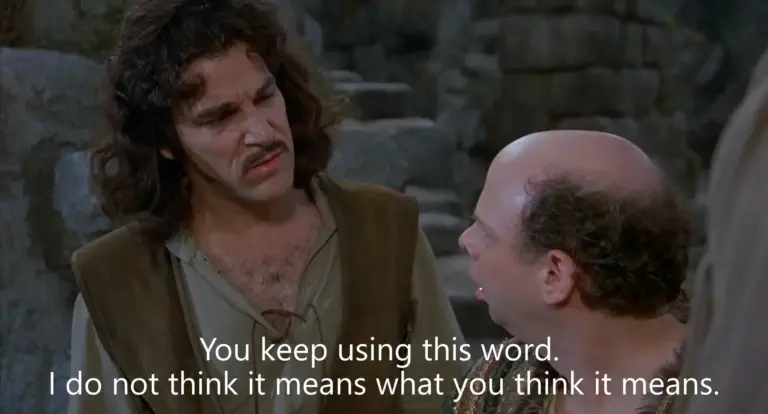
So, if you and your loved one are having a conflict about the same thing for the thousandth time, pause. Ask yourself: Does this conversation really mean what I think it means?

Photo: Inigo Montoya in The Princess Bride, via Disney+

If you discover a discrepancy between the situation and the reaction, lead with curiosity. The feelings are coming from somewhere real, even if it isn’t obvious at first. Then, use your emotional regulation skills to ground yourself in the present moment. Once you understand the meaning you’re making out of the content, validate yourself. Your emotions make sense! And finally, if the person you’re in conflict with is safe enough, have a conversation with them about what you’ve uncovered. In next month’s blog post, Karis will explore how to effectively communicate with your loved ones – check it out!

Aiming for Value-Driven Self-Leadership

Stop Shooting at Roadrunners

In my work as a marriage and family therapist, I often see individuals and couples stuck in frustrating and exhausting patterns. One of the most common—and surprisingly sneaky—patterns is what happens when we set our sights on a hoped-for outcome from someone else. I call it shooting at roadrunners. It happens when we aren’t congruent with our inner values and commitments, what I’ve termed value-driven self-leadership.

What are Roadrunners?

Imagine you’re in the desert. You’re trying to shoot your target, but instead of aiming at one that’s stationary, you’re tracking a fast-moving, unpredictable roadrunner. That roadrunner zigs, zags, hides behind rocks, and disappears just when you think you’ve got a clear shot. You keep aiming, adjusting, trying harder. You end up contorting yourself in vain, because you rarely hit the mark, and you’re left feeling depleted – and can easily start believing you are the problem.

What does the roadrunner represent? Trying to get a hoped for outcome from the other person. It’s the emotional gymnastics we do to try and get a desired response, such as validation, love, acceptance, gratitude, or control, while avoiding a feared response, such as anger, frustration or withdrawal from a loved one or friend. It’s thinking, If I just say it the right way, maybe they won’t get upset. Or If I give more, maybe I’ll finally be loved back the way I want.

In relationships, we shoot at roadrunners every time we:

  • Try to say the “right” thing to avoid conflict.
  • Change our behavior in hopes of controlling someone else’s response.
  • Hide our true feelings to maintain harmony.
  • Shape-shift into what we think others want us to be.

In short: Shooting at roadrunners is trying to change other people by changing yourself—at the cost of your authenticity. It’s letting outside factors inform what you do and how you show up, instead of acting intentionally in accordance with your values (value-driven self-leadership). It’s an exhausting game—and it rarely works.

The High Cost of Roadrunner Chasing

When we orient our behavior around what we think will get a certain response from others, we abandon our own internal compass. This doesn’t just exhaust us, it can erode intimacy, blur our boundaries, cause feelings of powerlessness, and create resentment. Over time we can lose sight of our values and feel disconnected from our true selves.

Here are some signs you might be caught in this pattern:

  • You frequently ask yourself, “What do they want me to say?”
  • You replay conversations in your head, wishing you’d done or said something different to “keep the peace.”
  • You feel like you’re losing touch with who you are and what you want, believe, or value.
  • You’re often disappointed or confused when your efforts don’t lead to the outcome you hoped for.
  • You anxiously watch to see how others respond to what you say or do, and you aren’t at peace unless they are okay (I call this outside-in peace).

Why Shooting at Roadrunners Doesn’t Work

Because the “target” is constantly moving. The other person’s moods, needs, triggers, and interpretations are outside your control. You might hit the mark, but it’s rare and you aren’t likely to hit it consistently. When your focus is on managing others instead of living from your own truth, you end up feeling anxious, resentful, and disconnected—from others and yourself.

But there is a rub here as well: you learned over time, likely starting in childhood, that shooting at roadrunners was needed either to protect or connect. You might be stuck in lifelong patterns, especially if they are connected to trauma. It might feel super scary to shift those patterns, and even when you feel you can, it isn’t easy! More on that later.

What If You Aimed at a Stationary Target?

There’s a healthier, more grounded alternative: stop aiming at the roadrunner. Instead, aim at a stationary target—something that doesn’t run, doesn’t hide, and doesn’t depend on someone else’s reactions.

That stationary target is value-driven self leadership. It looks like: “Who do I want to be in this moment?” If you’re a person of faith, it’s also, “Who is God calling me to be?”

It’s defined by your character, not by the outcome.

Imagine replacing “How do I get them to like me or do what I want?” with:

  • “How can I be kind and honest, even if they’re disappointed?”
  • “How can I express what I need while still being respectful?”
  • “How can I be assertive?”, meaning how can I honor and respect myself AND the other person?
  • “What are my values and am I living out of them?”
  • “What does integrity look like here?”

When you shoot at this kind of target, you’re choosing to live from the inside out – from a place of value-driven self leadership. Your peace comes from living congruently, and your actions become expressions of your values, not reactions to someone else’s behavior.

What if You Can’t Even Find the Target?

If you often felt unsafe as a child, or you experienced trauma, this journey needs a different approach. You may need to find healing from the impact of trauma memory, which isn’t “time stamped.” In other words, you don’t perceive that your thoughts, feelings, and body reactions are connected to the past event, even though they are. Then you can easily get triggered in the present because of the live wire left over from unhealed trauma. When that happens, you may not even realize that your reactions are memory; they all get connected to the current situation instead.


A hint that might be happening is when you or others observe that your reactions are much bigger than the situation might typically call for. And in those moments, you might very quickly (and even without your awareness) get dysregulated and switch to “fight, flight or freeze” mode. At that point, you can’t just choose to live out of your values; your brain can’t even access your values! If this applies to you, I encourage you to find healing through therapy. Our team members offer evidenced-based practices that go beyond talk therapy.

You might be aware of trauma in your history, but might still find yourself unable to follow through on shifting your target. It’s likely that your hesitation is pointing to an area that needs healing or developing. This is a great thing to bring into therapy. That way, whatever is blocking your ability to live in value-driven self leadership can be healed and matured. Over time, rather than outside-in peace or outside-in value, you can learn to live inside out, aligned with your values and commitments.

Shooting at a Target You Can Hit

It takes self-reflection and intention to set your target according to value-driven self leadership. First, you may find it helpful to define your values and commitments. Maybe you value integrity, compassion, honesty, and self-respect. Those become your targets. Second, make sure that your targets are stationary by using this test: can I hit this target even if the other person doesn’t agree or cooperate? Is this value or commitment in my control? For example, can I be kind even if someone else is reactive or unkind? Third, ask what does it look like practically when I live out of this value? If you need further help with defining your values and commitments, download this free worksheet.

What Changes When You Switch Targets?

When clients begin this shift—from chasing outcomes in others that they can’t control to embodying values—something beautiful happens. They feel more grounded. Conflicts become less about winning and more about being real. Relationships get more honest, more resilient, and, yes—more loving, even if messier at times.

And when others don’t respond how they hoped? They can still feel proud of how they showed up. Why? Because they aimed at something solid. Something that matters.

Additional resources for this article: OpenAI. (2023). ChatGPT (Mar 14 version) [Large language model]. https://chat.openai.com/chat

Boundaries Are Love: For Yourself and Others

There’s a quote I came across that stopped me in my tracks when I first read it:

“Boundaries are the distance at which I can love you and me simultaneously.”
           – Prentis Hemphill 

This really made me think. How are boundaries loving? How is distance good for a relationship? It seemed counterintuitive to me. However, as I sat with this statement more, it began to make sense.

What Boundaries Actually Are

Imagine going to the zoo with your family or friends. You’re enjoying the day, looking at all the amazing animals. However, you notice that the fences around the animal enclosures are simple chain-link. It doesn’t bother you too much when looking at the zebras or even the giraffes, but when you get to the tigers, lions, and bears (oh my!), you begin to feel uncomfortable and unsafe. You can no longer be present with the people around you or enjoy the animals because all you can think about is that flimsy fence separating you from a predator.

Boundaries are the fences we build in our lives and relationships so that there is safety to enjoy them to the fullest. This is why boundaries are so essential. They are an important part of our relationships because they allow us to determine how much access we give to others. They also provide the personal power to set limits on that access.

This doesn’t mean that setting boundaries is easy or comfortable. Quite the opposite. Setting boundaries is difficult, especially when we are not used to it. In fact, the people around us may not understand or may be angry that we’ve limited their access to us. However, when we feel empowered to set limits, we can show up in healthier ways because fear and resentment no longer control us.

So, How Do We Set Good Limits?

For something to be a boundary, four qualities need to be met. In the therapy world, we call this The Boundary Filter:

  1. A boundary must keep me safe. (If it doesn’t, it’s not a boundary.) Safety also doesn’t mean that boundaries won’t hurt emotionally or negatively impact my relationships. This filter is about keeping myself physically safe and minimizing mental and emotional damage.
  2. I must be willing and able to follow through on holding the boundary. (If not, it’s not a boundary.) This means that I am willing to enact the consequences if my boundaries are crossed. It also means the consequence is something I am able to do because it’s in my personal power to do it.
  3. The boundary must be 100% in my control. (If it’s not, then it’s not a boundary). A boundary is not, “If you do ____ then I will make you ___.” I have no power or control to “make” anyone do anything. To believe otherwise is to disempower myself and stay stuck. Boundaries are all about my personal power and what I can do to keep myself safe, while also showing up as healthy as I can.
  4. A boundary can be kept even if the other person disagrees. (If not, it’s not a boundary.) If a boundary’s consequences are 100% in my control, it means I can hold my boundary even if the other person disagrees, is upset, or pushes back. Again, boundaries are all about my personal power and what I have control over.

When to Set Boundaries

Now that we’ve covered the what, we can focus on the when. How do we know if we need to set boundaries with some people in our lives? There could be many signs that a boundary is needed.

The most common indicator I see in my clients and in myself is resentment. If I begin to feel resentment towards someone for what they do or what they ask of me, I know I need to pause and pay attention. There is probably a boundary that is being crossed or a limit missing from the relationship. Other signs that boundaries are needed could be anxiety, fatigue, or not wanting to spend time with someone.

Once you have the awareness that a boundary is needed, you must determine what it needs to be set around: yourself (your unhealthy coping) or them (others’ unhealthy behaviors). Your personal unhealthy coping might include people pleasing, taking responsibility for things and feelings that aren’t yours, over functioning in relationships to keep the other person happy, etc. Other people’s unhealthy behaviors include addiction patterns, victim mentality, demands on your time and energy, etc.

Boundaries Aren’t a Cure-All… But They Do Help!

Now here is the hard truth about boundaries: they aren’t necessarily going to make our pain go away. It’s probably going to hurt mentally and emotionally. They are going to change our relationships, and not always for the easier. They are going to cost us, because once we set the boundary, if it’s really a boundary, we give up the right to complain about the other person’s behavior. However, there are so many reasons to have hope.

Boundaries do improve our lives and can improve our relationships. In practicing healthy relational limitations, we learn to trust ourselves and our personal power to keep ourselves safe. We can experience existing relationships differently. Additionally, we can form new relationships in healthier ways with healthier people who will honor and respect our limits. We can be more empowered to ask for what we need from others without demanding. And we can wisely observe whether someone else is healthy enough to honor our vulnerability.

Stepping Into Your Power

Boundaries are both challenging and so lifegiving to us and our relationships. If you think that you would benefit from learning more about boundaries and how/when to set them, consider reaching out to a therapist. They will have resources to help you process and understand the importance of having your own voice and power.

I also lead groups for individuals who struggle with codependency, a variety of behaviors that show up in relationships as a means of maintaining a sense of control in unhealthy or unpredictable situations. Typical signs of codependency include: people-pleasing, lack of boundaries, low sense of self, difficulty recognizing and expressing emotions, and a need for control. If you think you could benefit from the group, please feel free to send me an inquiry at karis@waystonelmft.com.

Remember, boundaries are the means by which we love ourselves and others well.

Finding Healing in the “Both/And”

Confessions of an Asian American Mental Health Therapist

Author’s note: Personally, May is a special month for many reasons. It is Asian American Pacific Islander (AAPI) Month and Mental Health Awareness Month—two pillars of my identity and work. In honor of the intersection of Asian American mental health, I want to share from my experience as an Asian American and child of immigrant parents, including parts of the healing I have found in my journey. My hope is to offer curiosity, connection, and perspective to those who may find echoes of their own story in mine.

For nearly 40 years, my parents ran a Chinese restaurant. They opened it before I was born and continued until my junior year of high school. To me, the restaurant wasn’t just a business but rather a living, breathing member of our family. It was the focal point of our family’s life where our livelihood, identity, and sacrifices converged. As first-generation immigrants, my parents poured everything into that restaurant because it was their path to the American Dream. It was an opportunity for financial stability, security, and a better life – not only for them, but also for their children. Unknowingly, their pursuit came with an emotional cost.

Restaurant Kid

As a young child, I remember waiting for my mom to pick me up from school during the restaurant’s afternoon break. I’d be the last one standing outside. Then a teacher would escort me to the front office, where I’d call my mom and sit there waiting. I felt a quiet mix of embarrassment and worry, but I also told myself I couldn’t be upset because she is coming from the restaurant.

This reason became a source of comfort and justification. It was always the excuse I landed on because I knew my parents were working hard to provide for us. Relief would finally hit when I would see her rushing through the school doors. She’d profusely apologize to the front staff as they sighed and said not to let this happen again. (Of course, it likely would, as it was a frequent occurrence.)

As I grew older, being the last kid at dismissal evolved into being a latchkey kid entering an empty house after school. I’d wait with anticipation for my mom or dad to check up on me during the restaurant’s afternoon break. When I would finally hear the whirring of the garage, relief came as I knew that I wouldn’t be alone. But my relief was short-lived. During their break, they would tell me what to do for dinner, sneak in a short nap, and then rush back out to the restaurant for the dinner shift.

I often felt a mix of sadness and frustration, but I never complained. I kept silent, never expressing how I felt out of fear of dishonoring their hard work and sacrifice. They have to work. They have to go to the restaurant. They’re doing this for us. I swallowed my loneliness and confusion out of reverence and guilt. Especially during the economic downturn of the Great Recession, I watched my parents come home defeated and exhausted. I made sure to keep myself in line, to be good and obedient. In other words, to be quiet and not a bother.

The Wrestling

Years later, I found myself sitting on my therapist’s couch. She asked me where my beliefs about not being good enough and being a burden came from. I felt a familiar pit in my stomach and tightness in my chest, making it difficult to articulate what was going through my mind. My instinct was to protect my parents. I jumped into the narrative of their sacrificial love, of their hard work and efforts. I would play mental gymnastics to uphold my loyalty and reverence for my parents (hello, filial piety). As we continued to build safety in the therapy room, my fear of dishonoring my parents eventually softened. I was finally able to slow down this narrative. For the first time, I realized I had been so focused on honoring my parents that I overlooked another important person in the story — myself.

Attachment Always Wins

In The Myth of Normal, Dr. Gabor Maté writes that trauma is not just what happens to us, but rather what happens inside us. Children have two essential needs: attachment (a secure relationship with our primary caregivers) and authenticity (the development of our truest selves). But when we sense that our authentic selves might jeopardize attachment, we learn to suppress our feelings to stay connected, even if that connection is incomplete or painful. As he puts it:

“If the choice is between hiding my feelings, even from myself, and getting the basic care I need and being myself and going without, I’m going to pick the first option every single time. Thus, our real selves are leveraged bit by bit in a tragic transaction where we secure our physical and emotional survival by relinquishing who we are and how we feel.”

That was me. I internalized the belief that I had to shrink myself and sweep what I felt under the rug to honor my parents’ sacrifice. For years, it worked—until it didn’t. I felt the fragility of my mental health as it rested on this shaky foundation of a story I told myself for so long.

Therapy gave me a space to finally confront the feelings I had buried: the loneliness, the sadness, the confusion, and the anger. I must admit, I was shocked by how much anger there was. Then, from the shock of the anger, I felt guilt. I teetered between anger and guilt, trying to find someone or something to blame. C.S. Lewis once said, “I sat with my anger long enough until she told me her real name was grief.” I recognized that my deeper emotion was, in fact, grief. Grief for the parts of my childhood I had silenced, grief for the emotional needs I had ignored, and grief for the version of myself I had abandoned.

Embracing the Both/And

Grief was a necessary part of the process to see things for what they were and finally accept them. And through that grief, something softened. Eventually, the intensity of the anger and the guilt began to wear down, and the two versions of the story I oscillated between no longer felt fitting. I began to see my story with new eyes—not of blame or resentment, but of complexity and compassion. This is when a third version of the story emerged that included both my parents and me. I discovered a powerful shift in my rationale and experience: both/and thinking.


Both/and thinking honors nuance. It allows room for contradiction, complexity, and truth to coexist. It freed me from the binary thinking that forced me to choose between honoring my parents or honoring myself. The reality is that multiple things can be true at once. The power of both/and thinking isn’t just something I have witnessed in my own story. It is where many of my Asian American clients find healing when they learn they can hold both love and pain at the same time.

Examples of both/and statements that have helped me and many others on the journey:

  • I can love my parents and still feel angry about what I didn’t receive emotionally.
  • I can understand the trauma my parents carry and still hold them accountable for how they parented me.
  • I can honor their sacrifices and pursue a life different from what they envisioned.
  • I can see that emotional expression was not modeled in my family and still learn to express myself freely now.
  • I can feel guilt for setting boundaries and know that they are necessary for my healing.
  • I can honor their cultural values and still unlearn the silence or shame I was taught around mental health.
  • I can heal from my wounds and still hold space for my family’s complexities.
  • I can disagree with some cultural values I was raised with and still respect where they came from.
  • I can feel gratitude for my upbringing and acknowledge the need to heal from parts of it.
  • I can feel like I don’t fully belong in either my Asian culture or my American culture and still create a sense of belonging for myself.
  • I can cherish my family’s resilience and work ethic and still seek gentler, healthier ways to live.

Being an Asian American or child of immigrant parents is not about resolving contradictions that we often may find ourselves straddling. It is about learning to live in the contradictions, making room for nuance in a world that often demands clarity. This is a key component not only for Asian American mental health, but for everyone who feels torn between two truths. It is not an easy journey. But, with intention and care, we learn to expand our story to include all of it—our pain and our power, our grief and our gratitude.

Knowing Your Story

This is the sacred work of healing: looking inward and sitting with discomfort to unearth beliefs that no longer serve us and to reclaim the parts of ourselves we left behind. In doing so, we begin to plant new seeds of acceptance, perspective, and compassion that lead to the fruits of living more wholly, more freely, and more authentically than ever before.

Your story is still being written, and you don’t have to write it alone. Having someone to guide you through the process of embracing the both/and in your life story can be a powerful starting point. If parts of my story resonated with you, consider taking the next step toward deeper healing.

Maximize Your Therapy Investment

Ah, tax season. This time of year, finances are front-and-center in our focus. Money is one of those funny topics that can stir up many feelings (namely: fear and anxiety) because it’s closely tied to our sense of security. It can be a sacrifice to invest financially in your mental health! For this reason, I thought it would be helpful to provide some tips on how to maximize your investment in your healing journey, so that you can be sure your money is being used wisely and effectively!

The Fit of Your Therapist

Research shows that one of the biggest determinants of therapy outcomes is the therapist themself. Each therapist has their own unique style of therapy, and there are tons of different approaches and techniques. This variability means that not every therapist is going to work well with you! Sometimes people just clash or don’t “vibe” well, which makes it difficult for you to be open and vulnerable – a central component for making progress on your mental health journey.

Tips for determining fit:

1. Shop Around

If you’re just starting your journey, don’t be afraid to “shop around” for a therapist or counselor with whom you genuinely feel comfortable! Most therapists offer free consultations, which are a great opportunity to get a feel for how well (or not) you can work together. Try a few on for size to find the best fit for you before committing!

  • Check out our checklist of suggested questions to ask when interviewing potential therapists.

2. Offer Feedback

If you’ve been working with a therapist and you’re not seeing the progress you want, or if there are some things about their style that rub you the wrong way, try having a transparent conversation with them. Most therapists will welcome the feedback. We would rather know directly that something feels off to you so we have a chance to address it. After all, your healing is our ultimate goal, and we want to help facilitate that journey, not get in the way!

3. Find a Better Fit

If you feel like your therapist just isn’t the one for you and having a conversation with them hasn’t helped, then it might be time to find someone who better fits your needs. While it can be intimidating to start with someone new, it’s better in the long run to have a therapist you work well with! Try asking your current therapist or another trusted source for referrals; this can give you a head-start in the “shopping around” process.

Consider the Frequency of Your Sessions

Meeting weekly, especially at the beginning of therapy, can really jump-start your healing journey. Because the relationship with your therapist is so critical for therapy outcomes, establishing good rapport and trust early on in the process makes for faster, more effective work in the long run.

Also, if you’re working through trauma, you might consider altering the frequency of your sessions – if you need to meet every other week instead of weekly, you can do that! Make sure you have the time and energy to do the work in session when you have to move toward hard things. Be willing to take the risk and move toward the difficulty – the only way out is through! And that takes effort. It might be helpful to set aside some energy according to the difficulty level.

Set Clear, Achievable Goals

One great way to get the most out of your therapy dollars is to set clear goals. Your therapist should help with this process – it’s best if it’s collaborative! And knowing what you’re both working towards is incredibly helpful for keeping therapy on track so you don’t waste time (and money) exploring topics that don’t relate to your goals. Having clear goals also helps you to monitor the progress you make, so you can really see the effects your time, money, and effort have on your life and relationships.

Communicate Openly with Your Therapist

Transparency with your therapist is key to getting what you want out of therapy. If your therapist doesn’t know what’s really going on, then they can’t help you address it. To really get the most out of your therapy investment, try being honest about what you’re experiencing, what you’re wanting out of therapy, and how therapy is going.

Of course, sometimes we aren’t ready to talk about things – and that’s okay. If you’re curious about how to move forward in therapy when vulnerability is a barrier, take a look at Louise’s blog post, “What If I Don’t Want to Talk About It?”

Actively Engage in and Out of Sessions

When you genuinely participate in the therapy process, you increase the impact and value of your therapy investment. One way to do this is to write down thoughts and feelings beforehand or throughout the week as they come up. That way, you can walk into your session with an idea of what you want to address that day, or how your previous session has affected you.

Another great way to actively participate is to take notes in session. Then, review them later. If you’re working through deep or poignant issues, you might even keep a journal about your therapy experience. This is another helpful way to see how things have changed throughout your healing journey. You can also choose to share what you’re learning with a trusted friend or partner.

Apply What You Learn Outside of Sessions

Let’s say I wanted to learn how to play guitar. I go out and buy a pretty little acoustic, I make sure I have all the accessories I might need (picks, a strap, a tuner, a capo, etc.), and I even sign up for lessons. But then, the only time I actually play the guitar is during my lessons with my instructor once a week. You can probably imagine how slow my progress would be! Wouldn’t it be so much more effective if I were to practice outside of lessons? Even two to three times a week would get me so much further along.

The same concept applies to therapy. Research shows that another critical determinant of therapy outcomes is how diligently you apply what you learn in therapy to your everyday life. Just like with any skill you learn, practicing it for only an hour every week or two probably isn’t going to get you very far. This is why some therapists assign “therapy homework.” Homework provides structured opportunities to export what you talk about and build it into your life!

Be patient and persistent

Healing can take time. This is especially true when you’re addressing deep, long-standing wounds or trauma. Or when you’re unlearning patterns of behavior that have been part of your life for a long time. Borrowing wisdom from our old friends The Tortoise and The Hare, “slow and steady wins the race.” Be patient with yourself and with the process. And if you stick with it – staying engaged, transparent, and with the support of a trusted therapist to walk with you – your investment in therapy can reap remarkable changes that will stay with you for a lifetime.

What If I Don’t Want to Talk About It?

What Vulnerability in Therapy Looks Like, and Alternatives to Talk Therapy

I was recently chatting with an acquaintance about mental health, and an interesting question came up. The query was: “How do you do therapy if you don’t want to talk about what happened?” I suspect this is a more common thought than people admit, even though we are socially more open to talking about mental health and engaging in what most call “talk therapy.”

In my experience and observation, the mental hurdle of going into an office and opening up to essentially a stranger is daunting. It requires a ton of vulnerability! So, let’s consider what appropriate vulnerability looks like when starting therapy. Then, for situations when talking is not a good fit, let’s explore a couple of talk therapy alternatives that focus more directly on the brain.

How Vulnerable Should Therapy Be?

Especially for those who haven’t experienced therapy before, it can be helpful to understand what the intake process looks like. Your first therapy session will likely involve discussing:

  • A variety of assessment approaches, depending on the therapist
  • What you came there to talk about
  • Anything the therapist noted that they would like to ensure they fully understand (these topics can be sensitive)

However, let’s be clear: this does not require you to share every detail of your life history if you are not ready. Honest answers to questions are important (they are necessary to keep you and the therapy room safe), but you can take your time getting comfortable. You are allowed to feel out who the person on the other side of the room is. You’re allowed to start with building rapport. That way, when you open a topic that feels overwhelming, you can focus on the safety of your relationship with your therapist, rather than the discomfort of sharing with a stranger.

Please be honest if you are in a crisis, but we can unpack the emotional tangle when you are ready. If building trust at your own pace is a new concept for you, this could even be a good starting point for your therapy journey. Trust-building could be the focus of your initial conversations as you are getting to know your provider.

You get a say in how much you say

If you are someone who struggles with power structures due to your history, therapy may seem particularly vulnerable.  It can be important to remember that a healthy therapist will support your autonomy as a client.  Generally speaking, you should:

  • Be an active participant in deciding the pace
  • Know you have a choice whether you continue with that therapist
  • Have the ability to give feedback if an intervention is not benefiting you

That being said, you should feel (in time) that this is someone who you would accept influence from. If you find yourself questioning your therapist consistently, then it may be a good time to talk with your therapist about the source of those questions. It may be something you just need to process, or it may be that the therapist is not a good fit—and that is okay.

When to Look Beyond Talk Therapy

You may be thinking, “Okay, so I don’t have to open Pandora’s box immediately. I have autonomy… but what if I shut down when I try to talk about it at all?”  This is part of why the therapy field has been consistently growing in the area of “brain-based interventions.”  These are alternatives to talk therapy that address healing on a deeper level. Typically, I toss EMDR, Brainspotting, Neurofeedback, and (sometimes) other interventions like Somatic Experiencing and Hypnotherapy into this conversation.

For this post, I’ll speak primarily to Brainspotting and Neurofeedback as those are the two interventions I know best.  Now, the question may come up, “Why not EMDR?” For many, EMDR is a beneficial intervention to assist in trauma resolution. However, it requires active, clinician-guided reprocessing in session, so if your goal is not to reprocess openly, then this is not your best starting point.

The key thing about all of the brain-based interventions is that they appear to be tapping into direct brain functions to help calm the nervous system, promote trauma resolution, and/or healthy formation of new habits. I tend to begin recommending a client explore one of these talk therapy alternatives when:

  •  We have reached the end of things to talk about, but symptoms are not improving
  • When I have someone reach out who finds talk therapy too daunting
  • The list of symptoms spreads beyond most common mental health diagnoses into areas that have strong physiological impacts such as sleep, chronic pain, traumatic brain injury (TBI), and panic
  • There are multiple diagnoses or symptoms that are impacting daily life
  • There are clear indicators that trauma resolution needs to be the focus

Brain-Based Interventions

For someone who wants to reap the benefits of symptom improvement without having to constantly process externally, Neurofeedback (NF) provides a route forward. Neurofeedback is a form of biofeedback where you watch a movie or other visual feedback. Simultaneously, electrodes collect and transmit information regarding the electrical activity in your brain. If you wish to sit in silence, chat about the weather, or discuss the latest book you read, we can do that—even while your brain is learning and processing this information.

Your job in the session is to watch the screen, listen to the audio feedback, and periodically check in about what your body and mind are experiencing. As you go along and the nervous system calms, the idea of exploring your internal world and thoughts may even become less daunting. If that occurs, we can shift to more trauma-focused NF work, where you can internally process those events while in a relaxed, sleep-like state called Alpha-Theta.

For someone who is okay focusing on the event or the associated emotions and physical sensations, Brainspotting may be a beneficial option. This intervention involves focusing your gaze on a spot in your visual field and observing your internal response, both physical and emotional. Brainspotting is a very client-led approach, allowing your autonomy to shape the pace and focus of your sessions.

This technique may surface uncomfortable memories; however, you are the gatekeeper. You can choose not to share your experience with your therapist – you can talk as little (or as much) as you want! The only time it’s necessary to let your therapist know what you’re experiencing is if you become overwhelmed. Even then, you don’t need to discuss the content – your therapist can help you ground and regulate without knowing any details.

Moving Forward with Talk Therapy Alternatives

So, what do you think? Would therapy be less intimidating to consider if you knew you could set the pace for vulnerability and have non-talk therapy options? At Waystone Therapy, we are all providers of at least one brain-based intervention, including Brainspotting and EMDR. Want to understand what these interventions might look like for you? I (Louise!) am a Neurofeedback provider.  Beth, Karis, and Kiki all provide Brainspotting, and Beth and Karis provide EMDR. The Waystone team is always happy to talk you through deciding what interventions are a fit for your needs. Wherever you are in your therapy journey, I hope this helps you conceptualize your path forward!